End-to-end redesign of Chase's rewards platform across 36 credit card portfolios, serving 45M cardholders on mobile native, hybrid, and web.

End-to-end redesign of Chase's rewards platform across 36 credit card portfolios, serving 45M cardholders on mobile native, hybrid, and web.

client

JPMorgan Chase

year

2022-2025

timeframe

Ongoing

role

Lead UX Designer

outcome

18% reduction in call volume · 11% increase in redemption completion rates · NPS improvement 2023–2025

WEB

HYBRID

IA

chase.com
Problem

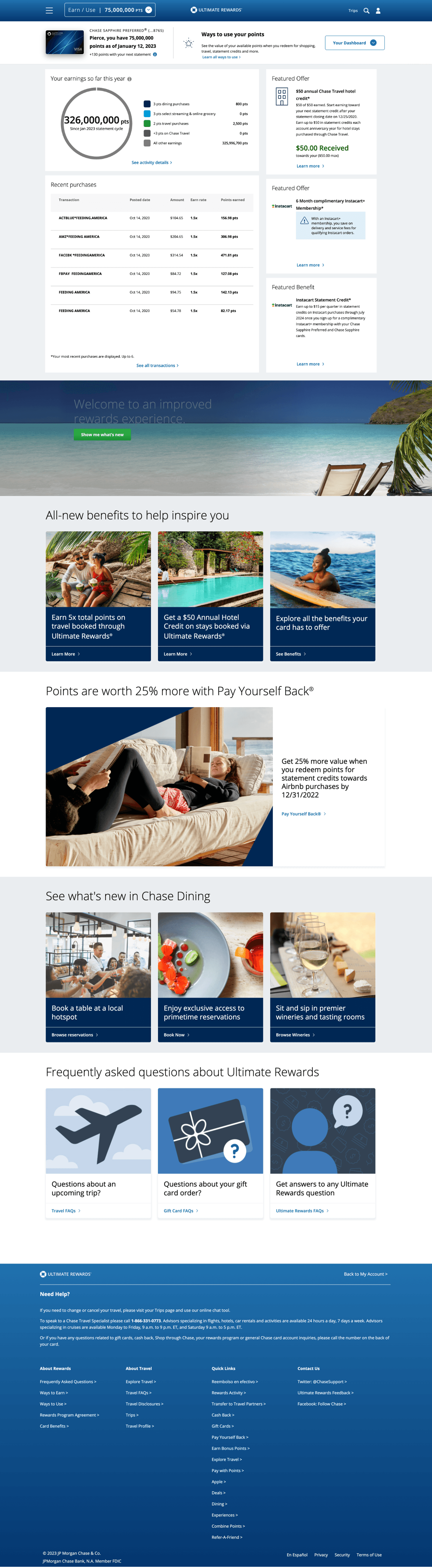
Chase's rewards platform was built and maintained by a third-party vendor. The result: an experience that looked like an e-commerce site, was inconsistent with Chase's design system, overwhelmed users with promotional content, and offered poor mobile support — forcing users to scroll past dense information to reach what they came for.

Solution

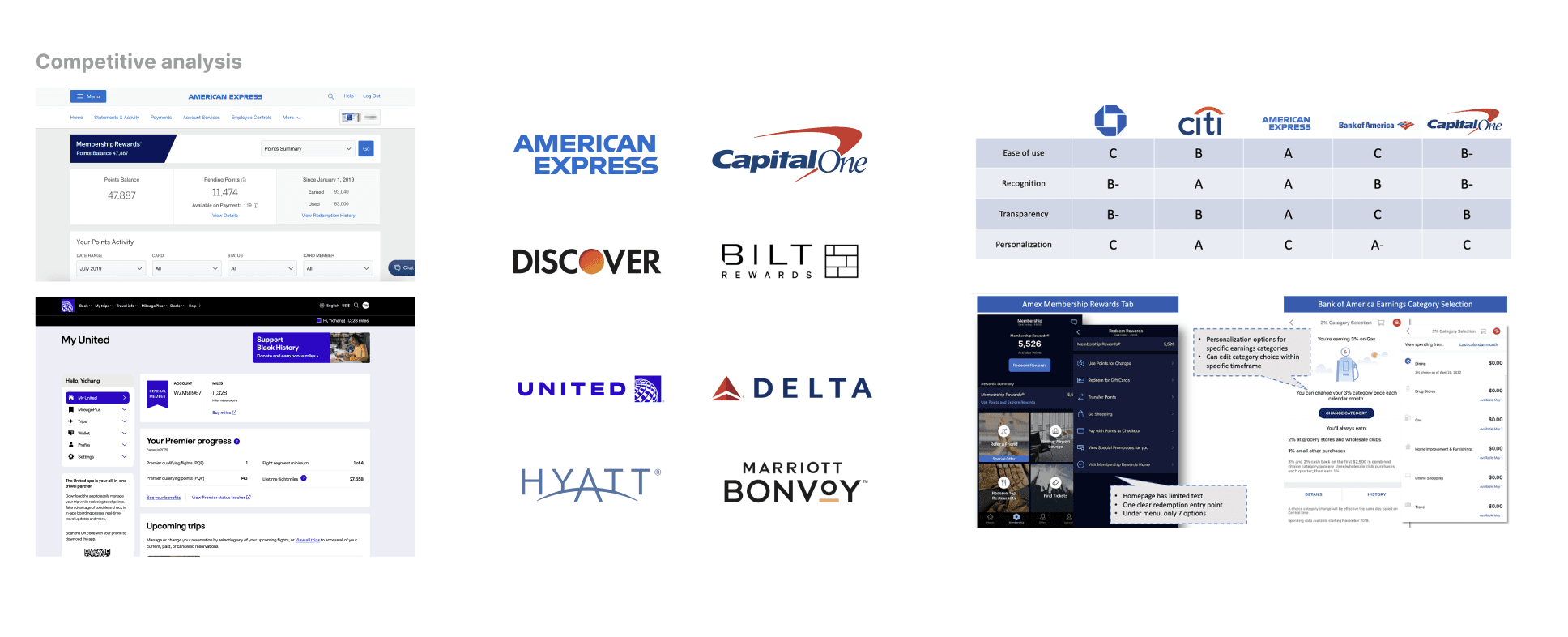
High call volumes and declining NPS confirmed what the experience felt like. Chase formed a dedicated in-house team to take full ownership of the platform — rebuilding it from the ground up with a focus on user clarity, mobile-first design, and long-term scalability.

chase.com/ultimate-rewards
2022
Legacy
2024
Phase 1
2026
Phase 2
0M
Chase credit cardholders
0B+
Points redeemed monthly
0+
Co-brand partners integrated

The Ultimate Rewards platform is Chase's primary touchpoint for credit card loyalty — connecting cardholders to redemptions across travel, cash back, gift cards, partner transfers, and co-brand programs. It directly influences JD Power scores and long-term customer retention.

Core Insight

Two users,
one homepage.

Task-Oriented

Arrives with a specific intent — check balance, redeem points, then leave. Promotional content feels intrusive. Every extra step is friction.

Explorer

Arrives without a clear goal, open to discovering value. But the legacy design offered no structured path — just noise.

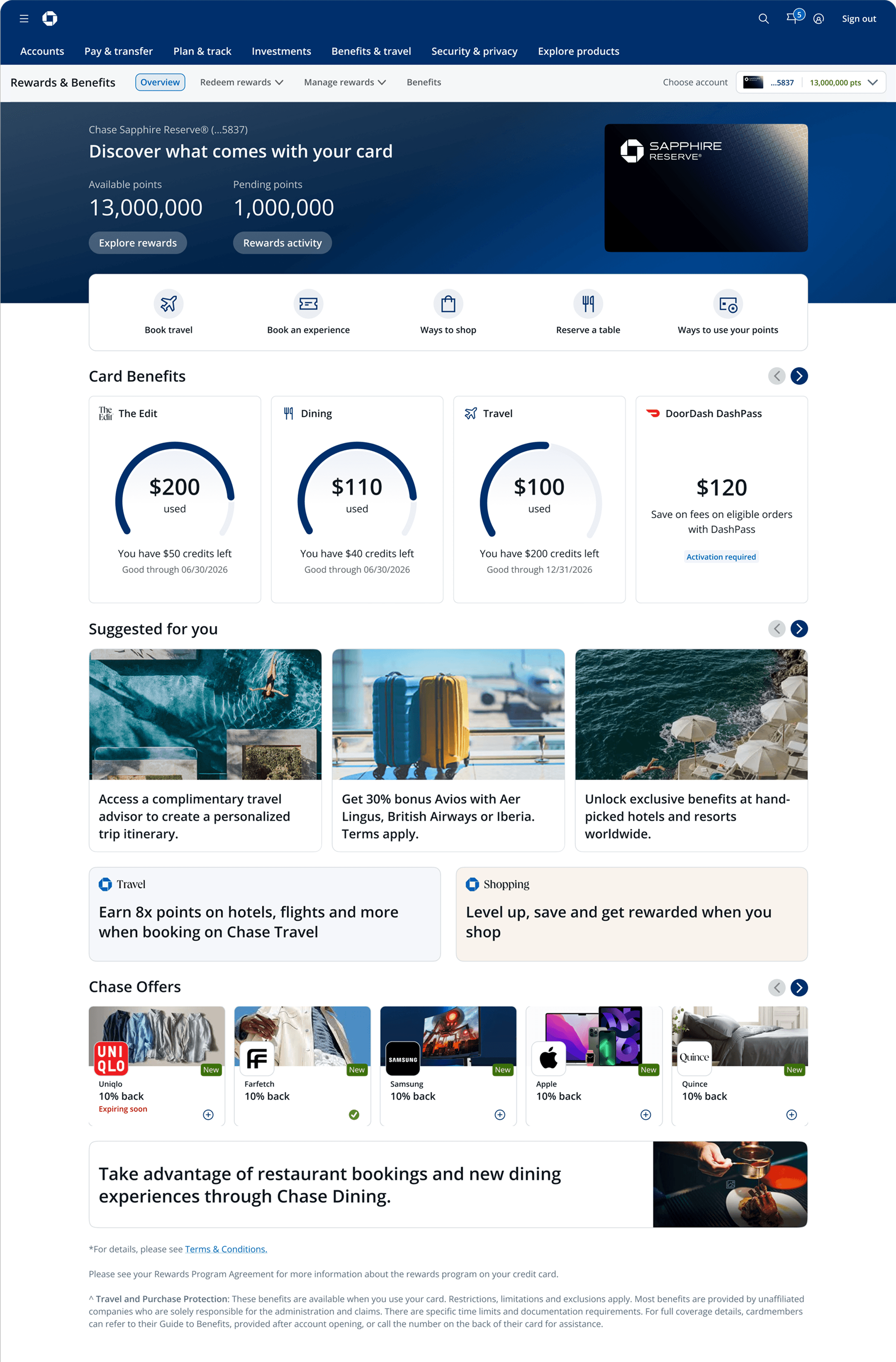
Research revealed that users arrived at the UR homepage with fundamentally different mindsets. Some came with specific intent — redeem points, check balance, then leave. Others arrived without a clear goal and were open to discovery. The legacy design served neither well.

The design direction had to balance both — enabling fast, frictionless task completion while creating moments of deliberate discovery. This tension shaped every layout and hierarchy decision that followed.

Phase 1 · 2023–2024

How we shipped it without breaking what users knew.

Rather than a single cutover, I worked with the PM to define a module-by-module migration strategy — replacing legacy sections incrementally over six months. The sequencing was deliberate: modules with the highest user dependency launched first, allowing us to capture early feedback and de-risk subsequent releases. Each launch was informed by VOC analysis, unmoderated usability testing, and A/B testing on specific components.

Key Constraints
01
Can't break 45M users' mental models
Any sudden layout change would spike call volume immediately. Every shipped module had to feel familiar enough to not trigger confusion — even when the underlying structure changed significantly.
02
Rebuilding while the product stayed live
No design history from the vendor, no component library, no documented patterns. We were building the foundation while shipping on top of it — every decision had to work both now and at scale.
03
Every decision had to scale across 36 card products
Each design choice needed to hold up across different card tiers, co-brand partner requirements (United, Disney, Marriott, Amazon), and benefit structures — without creating 36 separate design paths.
What shipped
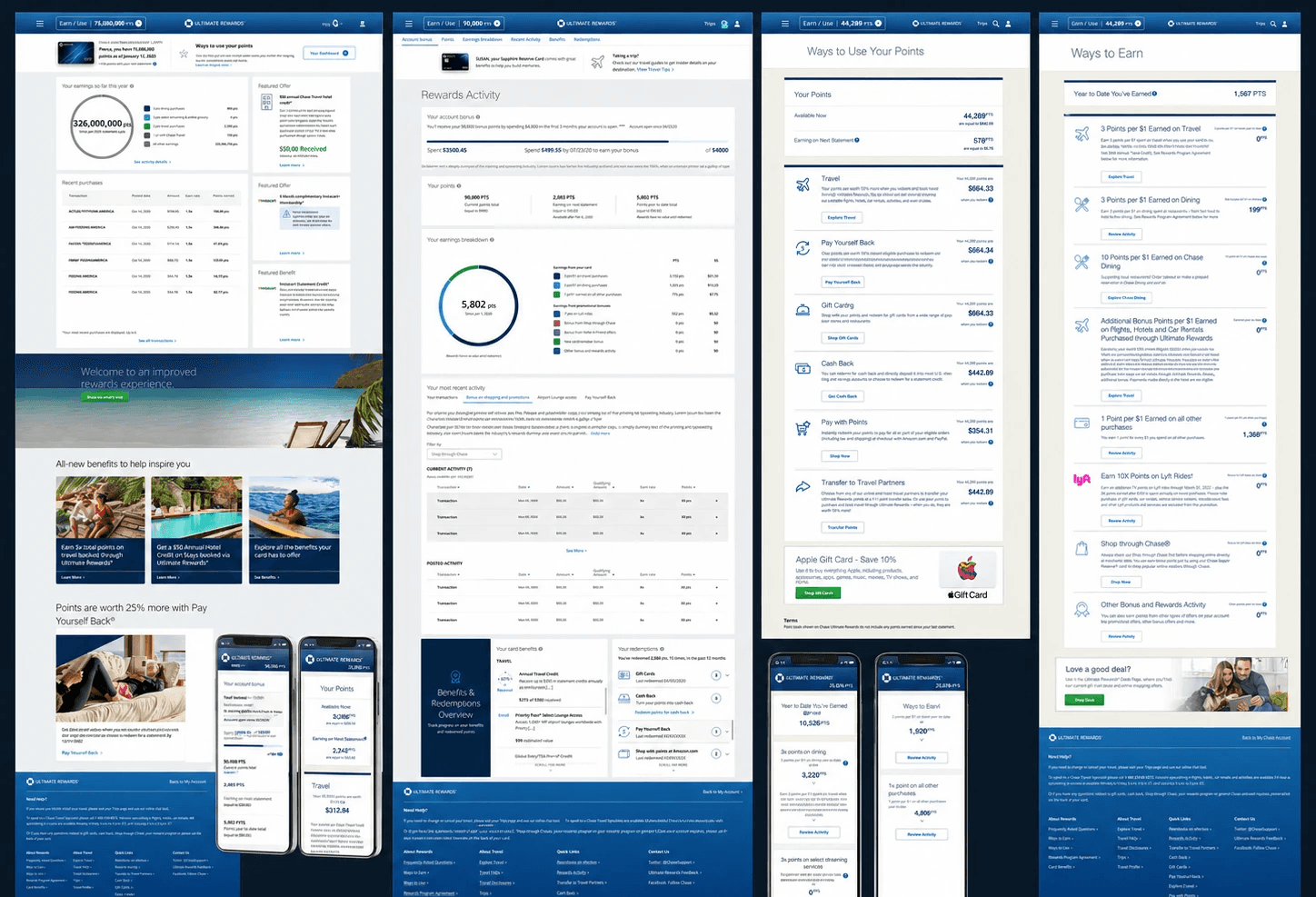
01
Homepage
Rebuilt from banner-heavy layout to modular tiles with clear visual hierarchy, enabling both task completion and content discovery.
02
Rewards Activity
Redesigned for scanability; improved filtering and activity organization to reduce call center dependency.
03
Ways to Use
Replaced dense text blocks with a single-column tile layout — outperformed 2-column in testing. Promotional content redistributed inline.
04
Ways to Earn
Consolidated card-specific bonus categories for clarity across 36 card portfolios.
05
Deals Page
Integrated into UR navigation; centralized merchant offers and partner redemption opportunities.
06
Mobile
Full responsive redesign addressing scroll depth, information prioritization, and navigation accessibility.
Phase 1 · Impact

Results that held up across every OKR cycle.

0%
Reduction in customer service calls
0%
Increase in redemption completion rates
0%
Rewards Activity visits from homepage
0%
Ways to Use visits from homepage
0+
NPS score post-launch
Visuals

Before & After

Upload Before image
Before
Click image to compare before & after
Before
After
Phase 2 · 2025
ONGOING

Leading the next generation of UR.

With Phase 1 metrics as foundation and a new set of business OKRs — including new card launches and holistic brand refreshes across Chase Travel and Shopping — I took on the design lead role for Phase 2.

This meant translating complex, multi-stakeholder inputs into a prioritized design roadmap: identifying which problems required UX intervention, scoping solutions within dev capacity, and coordinating with the design system team and research to validate direction before full build.

Early signals
0%
Reduction in time spent on navigation interactions
0%
Reduction in desktop homepage height
0%
Reduction in mobile homepage height
0%
Increase in scroll completion
0%
Increase in Cash Back module click-through
0%
Increase in Chase Travel click-through
0%
Increase in Gift Card click-through
Full release scheduled Q3 2025
Reflection

What I learned shipping at this scale.

Shipping module-by-module meant we could learn and adjust without putting 45M users at risk. Each launch informed the next.
A/B testing before committing to layouts prevented expensive reversals. The single-column Ways to Use layout is a direct example.
Agreeing on module priority with PM upfront kept engineering, content, and design working toward the same milestone.
Open to Senior & Principal IC UX roles
Let's make
Franky Wang · 2026